
Solar Panel Calculator
How big a solar system do you need, and how long will it take to pay for itself? Enter your electricity use and your area’s sun hours to estimate the system size, number of panels, roof space and yearly output — then the cost, incentives and payback. A second calculator handles the cell and wiring math: power, efficiency and how series and parallel strings add up.
- Free to use
- No sign-up
- Runs in your browser

Solar panel calculator
Solar cell and string calculator
Solar Planning Pack
Excel solar sizing and payback workbook, a monthly production tracker, a site assessment checklist and a string wiring worksheet.
- Sizing workbook (XLSX)
- Production tracker (PDF/DOCX/XLSX)
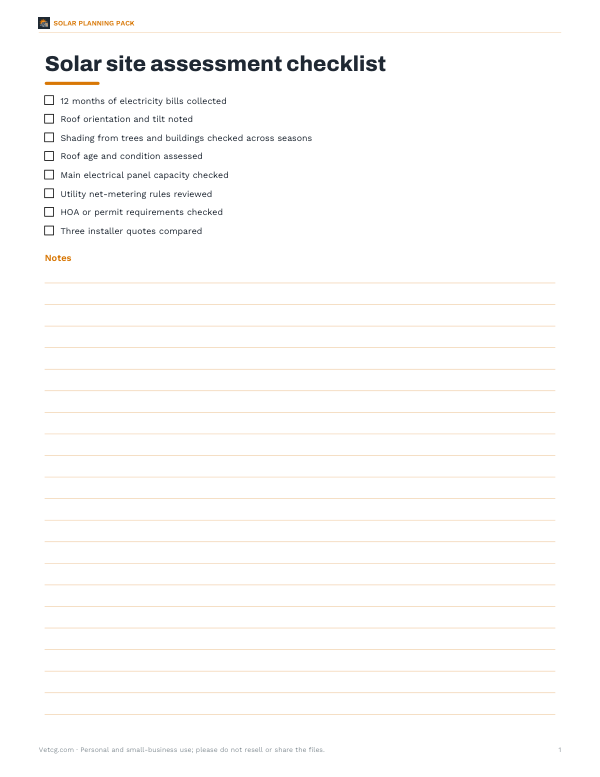
- Site checklist (PDF/DOCX)
- Wiring worksheet (PDF/DOCX)
Formats: XLSX, PDF, DOCX. Instant download after payment (link valid 72 hours, up to 5 downloads). AI-assisted: the templates were drafted with AI help and reviewed and laid out before publishing.
$5.00 USD, one-time 4 files · about $1.25 each
- Instant download
- 7-day refund
- Secure checkout by Stripe
7-day money-back guarantee. Full refund within 7 days of purchase, even after you download.
Free sample: Monthly Production Tracker (PDF, 51 KB)
Full refund within 7 days — see the refund policy and license.
Free printables
Single sheets you can print right now, no sign-up. The full pack adds every sheet in one download plus the editable files.
 Printable Solar Wiring Worksheet
How the sizing works
- Find your yearly electricity use in kWh — add up 12 months of bills.
- Choose how much of it you want to offset.
- Divide by 365 and by your location’s average peak sun hours to get kWh per day per kW of panels.
- Divide again by a system losses factor (often around 0.75–0.85) for inverter, wiring, heat and dirt losses.
- Divide the system size by one panel’s rating to count panels.
System size (kW) = yearly kWh ÷ (peak sun hours × 365 × losses factor). “Peak sun hours” is the daily solar energy expressed as hours of full 1,000 W/m² sunshine.
Typical peak sun hours
| Location | Approx. annual average (hours/day) |
|---|---|
| Seattle, WA | 3.5 |
| Boston, MA | 4.3 |
| Chicago, IL | 4.4 |
| New York, NY | 4.4 |
| Atlanta, GA | 5 |
| Denver, CO | 5.4 |
| Los Angeles, CA | 5.8 |
| Phoenix, AZ | 6.5 |
These are approximate yearly averages for a south-facing tilted array and vary with orientation and local weather. NREL’s PVWatts calculator gives location-specific estimates for any US address.
Worked example
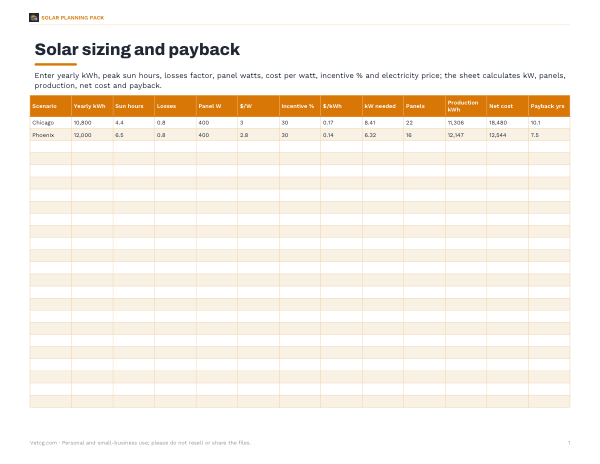
A household uses 10,800 kWh a year (900 kWh a month) and lives near Chicago with about 4.4 peak sun hours. With a losses factor of 0.8, it needs 10,800 ÷ (4.4 × 365 × 0.8) = 8.41 kW. With 400 W panels that’s 22 panels (8.8 kW), roughly 462 sq ft of panels, producing about 11306 kWh a year. At $3 per watt the installed cost is about $26400; with a 30% credit, $18480. Saving 10,800 kWh at $0.17 is $1836 a year, for a simple payback of about 10.1 years. All of these inputs are adjustable, and incentives and prices vary.
Solar cell basics
| Term | Meaning |
|---|---|
| Voc | Open-circuit voltage — no current flowing |
| Isc | Short-circuit current — no voltage |
| Vmp, Imp | Voltage and current at the maximum power point |
| Pmax | Vmp × Imp |
| Fill factor | Pmax ÷ (Voc × Isc) — how “square” the I–V curve is |
| Efficiency | Pmax ÷ (irradiance × area); STC irradiance is 1,000 W/m² |
| STC | Standard test conditions: 1,000 W/m², 25 °C cell temperature, AM1.5 spectrum |
A typical crystalline silicon cell has a Voc around 0.6–0.7 V. Panels wire many cells in series to reach a useful voltage; a “120 half-cell” panel wires 60 pairs of half-cells. Series connections add voltages, parallel connections add currents.
What affects real output
- Orientation and tilt: south-facing (in the northern hemisphere) at a tilt near latitude usually produces the most.
- Shading: even partial shade on one panel can reduce a string’s output unless optimisers or microinverters are used.
- Heat: panels lose a little efficiency as they get hotter.
- Dirt, snow and ageing: output declines slowly over the years — datasheets state a degradation rate.
- Inverter sizing and clipping.
Batteries and backup power
A grid-tied system without batteries usually shuts down during a power cut for safety, even in full sun. Adding a battery lets you keep essential circuits running and, on some tariffs, store daytime solar for the evening peak. Size a battery from the loads you want to back up and for how long — for example, a refrigerator, lights, internet and a few outlets for an evening — rather than from the solar array size. Battery capacity is given in kWh; usable capacity and power output (kW) both matter.
Panel wattage and roof space
| Panel rating | Typical size | Panels for 8 kW | Approx. panel area |
|---|---|---|---|
| 350 W | ≈ 17.5 sq ft | 23 | ≈ 400 sq ft |
| 400 W | ≈ 21 sq ft | 20 | ≈ 420 sq ft |
| 430 W | ≈ 21.5 sq ft | 19 | ≈ 410 sq ft |
Higher-wattage panels are usually physically larger, so the roof area needed for a given kW changes less than the panel count. Efficiency — watts per square foot — is what matters when roof space is tight.
Before you buy
- Get quotes from several licensed installers.
- Check your utility’s net-metering or export rules — they strongly affect savings.
- Confirm incentives and eligibility with official sources or a tax professional.
- Ask about roof condition: replacing a roof after installing solar costs extra.
- Compare warranties for panels, inverters and workmanship.
Privacy
All calculations run in your browser.
Frequently asked questions
How many solar panels do I need?
Divide your yearly kWh by (peak sun hours × 365 × losses factor) to get kW, then by the panel wattage.
What are peak sun hours?
Daily sunshine energy expressed as hours of full 1,000 W/m² sun.
How much roof space do panels need?
Roughly 18–22 sq ft per panel, plus spacing and code setbacks.
How do I calculate a solar cell’s efficiency?
Pmax ÷ (1,000 W/m² × cell area in m²) × 100%.
What happens when panels are wired in series?
Voltages add while current stays the same.
Is this estimate exact?
No — it’s a planning estimate; get a site assessment for real figures.
Do solar panels work on cloudy days?
Yes, at reduced output; annual averages already include typical weather.
How long do solar panels last?
Panel warranties commonly run 25 years or more, with output declining slowly over time.
What does the losses factor include?
Inverter efficiency, wiring, temperature, dirt and mismatch — often 15–25% combined.